
Why Your Business Needs an AI Search Monitoring Platform
Search is fundamentally changing. Users are increasingly getting information through AI search (like conversational search, answer engines) instead of traditional “click-the-link” methods. This means: your brand could be “summarized” without you knowing how it's being presented.
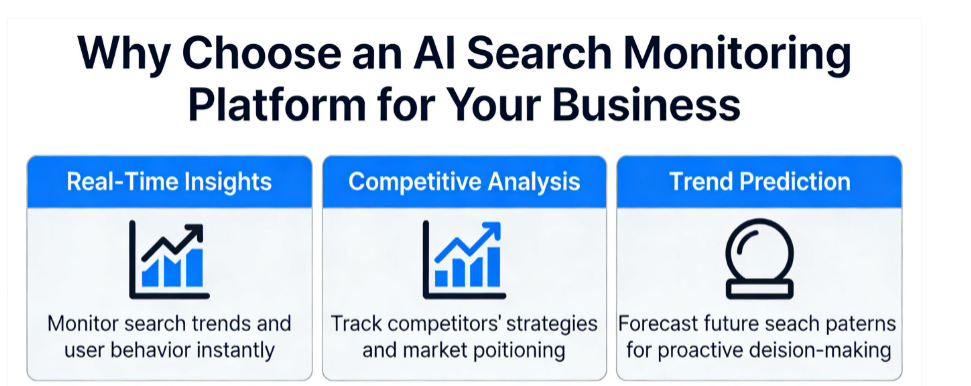
That’s exactly why AI search monitoring platforms exist.
Here’s the real value—no fluff.
1. You Need to Know: How AI “Talks About” You
Traditional SEO focuses on:
👉 What rank you’re at
👉 How many clicks you get
But in AI search, it becomes:
👉 Whether AI mentions you at all
👉 Is it positive or negative
👉 Who you’re being compared against
The problem: you can’t see any of this in Google Search Console.
An AI search monitoring platform helps you:
Capture AI answers (like “recommended tools” or “best brands”)
Identify if your brand gets mentioned
Track ranking (not link ranking, but “position in the answer”)
👉 Essence: shifting from “link ranking” to “content presence.”
2. Discover Keywords Where You’re Being “Replaced”
AI search has a real impact: a lot of traffic is simply being eaten by AI.
For example, when users search:
“best CRM tools”
“how to choose a laptop”
Previously, users would click through to websites. Now they might just read the AI summary.
An AI search monitoring platform helps you:
Find which keywords are already being answered directly by AI
Identify questions where you don’t appear
See which competitors get recommended frequently
👉 You’ll see: it’s not that your ranking dropped—it’s that search behavior changed.
3. Find Content Directions That Actually Work (Instead of Guessing)
Many people still create content the old way:
Look at keywords
Write articles
Wait for rankings
But AI search cares more about:
Whether you directly answer the question
Whether your structure is clear
Whether you’re cited multiple times
AI monitoring platforms give you this intel:
Which content types get picked by AI more often (lists? tutorials? comparisons?)
What paragraph structures AI frequently cites
Which questions aren’t well-answered yet (opportunity gaps)
👉 You’re not just “writing content”—you’re training AI to pick you more easily.
4. Monitor Competitors: Who’s Eating Your Exposure
In AI search, competition works differently:
Not 10 blue links anymore.
Instead: 3–5 recommended names.
AI search monitoring helps you:
See which questions competitors get recommended for
Analyze their content structure (why they got picked)
Find gaps they haven’t covered
👉 Often you’ll discover: it’s not that you’re bad—it’s that they’re more “AI-friendly.”
5. Catch Brand Risks Early (This Is Critical)
AI “summarizes information,” but not always accurately.
Issues can arise:
Outdated info
Misleading descriptions
Negative content amplified
If you’re not monitoring, you’re essentially saying:
👉 The “you” that users see isn’t defined by you.
An AI search monitoring platform can:
Detect errors or negative descriptions in real-time
Track which sources influence AI output
Help you make quick content corrections
👉 This is becoming one of the core capabilities of future brand management.
6. Get Ahead Instead of Playing Catch-Up
Many businesses haven’t realized one thing yet:
AI search ≠ the future. It’s happening now.
By the time traffic drops, it’s usually too late.
The value of using a monitoring platform:
Establish data baselines early
Continuously optimize content structure (GEO)
Track AI visibility trends
👉 You’re doing one thing:
turning “invisible AI traffic” into analyzable data.
Summary (Plain English Version)
Why use an AI search monitoring platform?
Because you need to figure out three things:
Does AI mention you?
How does it evaluate you?
Why does it pick you (or not)?
If you’re still only looking at traditional SEO data, you’re only seeing the “old world.”
AI search monitoring solves this:
👉 your real position in the new search ecosystem.